Abdominoplasty removes excess lower-abdominal skin/fat and—most cases—repairs stretched or separated muscles (diastasis) to create a flatter, firmer profile. It is not a weight-loss procedure; results are best at a stable weight, and future weight changes/pregnancy can undo improvements.
Many surgeons now use progressive tension sutures to reduce the space where fluid collects; this “drainless” approach can lower seroma risk in selected patients (data supports benefit but is not uniform across all studies). Cost in Canada varies with the technique used, whether muscle repair is included, and the facility and anesthetic fees a clinic charges. Most people take two to three weeks off desk work and wear compression for roughly six weeks, and the hip-to-hip scar is placed low so underwear covers it as it matures. Where there is loose skin only below the navel, surgeons often weigh a full abdominoplasty against a mini tummy tuck, so recommendations and results vary by patient and by provider.


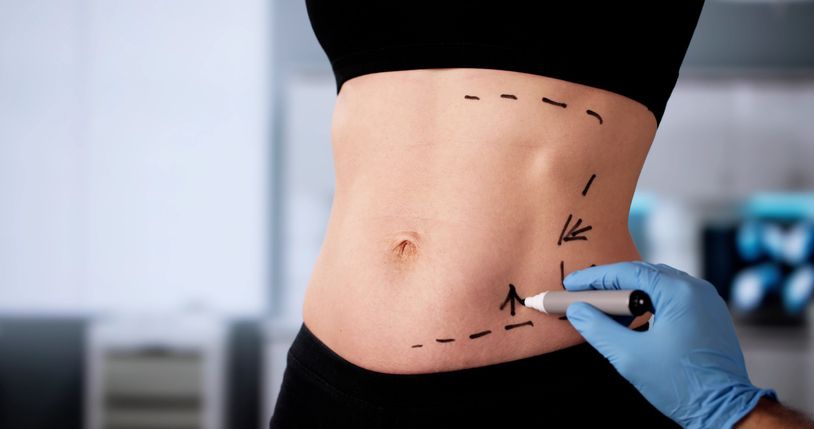


The quoted price usually bundles the surgeon's fee, the anesthetist and the facility, and it moves with how much work the operation involves. A full abdominoplasty with muscle repair costs more than a mini, and an extended or circumferential version more again because it treats the flanks and back as well. Where the operation is done matters too, since a hospital theatre and a private accredited facility are not priced the same. Ask specifically whether compression garments, follow-up visits and any revision are included, because those are the items that vary most between quotes. Abdominoplasty done for appearance is not covered by provincial plans, though a panniculectomy for a documented medical problem sometimes is.
Expect to be walking, slightly bent forward, the same day, and to feel tightest across the abdomen for the first week. Most people take two to three weeks off desk work and longer for work involving lifting or standing all day. A compression garment is usually worn for about six weeks, and drains, if used, come out within the first week or two. Muscle repair makes the recovery more uncomfortable than skin removal alone, because the repaired sheath needs protecting from strain. Strenuous exercise and heavy lifting are generally cleared at around six weeks. Swelling settles gradually rather than suddenly, and it is normal for it to come and go through the day for several months.
A full abdominoplasty leaves a horizontal scar low across the lower abdomen, placed so that underwear and most swimwear cover it, plus a small scar around the navel where it is brought through to its new position. Its length depends on how much loose skin is removed, so a larger correction means a longer scar. It looks red and raised for the first few months, then flattens and pales over roughly twelve to eighteen months. Surgeons often recommend silicone sheets or gel, sun protection and taping once the wound has closed. People who scar thickly or form keloids should raise it before surgery, since it changes both the plan and the expected result.
The change in shape is visible immediately, but swelling hides the detail for some time. Most of the obvious swelling settles by six to eight weeks, which is when the contour starts to look like the result. The last of it, particularly just above the scar, can take six to twelve months to resolve fully. Results hold well provided weight stays stable, because the operation removes skin and tightens muscle rather than preventing new fat from being stored. A later pregnancy will stretch a repaired muscle sheath again, so surgeons commonly suggest waiting until you have finished having children.
Check that the surgeon is certified in plastic surgery by the Royal College of Physicians and Surgeons of Canada, and confirm it on the provincial college register rather than taking a website's word for it. Ask where they operate and whether the facility is accredited, since abdominoplasty is a general anesthetic procedure with a real complication profile. Ask how many they perform a year, to see before and after photographs of patients with a similar starting point, and how they handle complications such as seroma or wound healing problems. A surgeon who tells you that you are not yet a good candidate, or that your weight should be stable first, is giving you useful information rather than losing your business.
They differ in how much they remove and whether muscle is repaired. A mini addresses loose skin below the navel only, uses a shorter scar, leaves the navel where it is and often skips muscle repair. An extended or fleur-de-lis version adds a vertical scar to take in width as well as height, and suits people with a large amount of loose skin, often after major weight loss. A panniculectomy removes the overhanging apron of skin for medical reasons such as recurrent rashes or infection, without tightening muscle or contouring for appearance. Which one fits depends on where your loose skin sits and whether the muscles have separated.
There is no medical difference between a tummy tuck and abdominoplasty. “Tummy tuck” is the common name, while abdominoplasty is the clinical term for the same surgical procedure. It typically removes excess abdominal skin and fat and may repair separated or weakened abdominal muscles. The exact surgical technique and treatment area depend on the patient’s anatomy and goals. A qualified plastic surgeon can explain whether a full, mini, or extended abdominoplasty is the most appropriate option.
Someone may consider abdominoplasty to address loose abdominal skin, separated abdominal muscles, or stubborn tissue that has not improved with lifestyle changes. These concerns can develop after pregnancy, significant weight loss, aging, or changes in body shape. Abdominoplasty is a body-contouring procedure, not a weight-loss treatment, and it cannot guarantee a particular appearance. Suitable candidates are generally healthy, near a stable weight, and able to accommodate the required recovery period. A consultation with a qualified plastic surgeon can clarify whether the procedure aligns with the patient’s anatomy, health, and expectations.
After anesthesia, the surgeon makes a low horizontal incision, lifts the skin/fat flap, repairs weakened muscles (if indicated), removes excess tissue, repositions the navel in full/extended cases, and closes the incision (with drains or drainless progressive tension sutures).
Best candidates are healthy, non-smokers at a stable weight with extra lower-abdominal skin (often after pregnancy or weight change). Abdominoplasty is not a substitute for weight loss; plan surgery after childbearing when possible.
General surgical risks (bleeding, infection, wound issues), seroma, DVT/PE (blood clots)—abdominoplasty has a higher major-complication rate than many cosmetic procedures; VTE risk is real and higher when combined with other operations. Surgeons mitigate risk with individualized VTE assessment (e.g., Caprini score), early ambulation, and compression/chemoprophylaxis for higher-risk patients.
Instead of drains, surgeons place progressive tension sutures to tack the flap down and eliminate “dead space.” Meta-analysis and reviews suggest this can lower seroma rates and improve comfort, though outcomes depend on technique and patient factors.
Yes. Professional guidance links nicotine to wound-healing problems. Many plastic-surgery sources advise stopping at least 4 weeks before and remaining nicotine-free 3–6 weeks after (your surgeon will specify).
For the right candidate—stable weight, realistic goals—tummy tuck provides durable contour improvement and can address muscle laxity that exercise can’t fix, with the understanding of the downtime and risks above.
 English English
  French


