Earlobe reduction, also called lobuloplasty, trims and reshapes earlobes that have become enlarged or elongated. The change is usually caused by ageing, genetics, or years of wearing heavy earrings, which gradually stretch the lobe. It is a minor in-office procedure under local anaesthetic, takes about 30 to 60 minutes per ear, and the scar is placed along the edge of the lobe where it is hard to see.
Most people are back to normal within a couple of days, though the ear should be protected from anything that could catch or pull it while it heals. If your lobe is split or torn through rather than simply stretched, torn earlobe repair is the procedure that addresses that, and the two are sometimes done together. Scars mature over several months, so the final appearance takes longer to settle than the recovery itself.


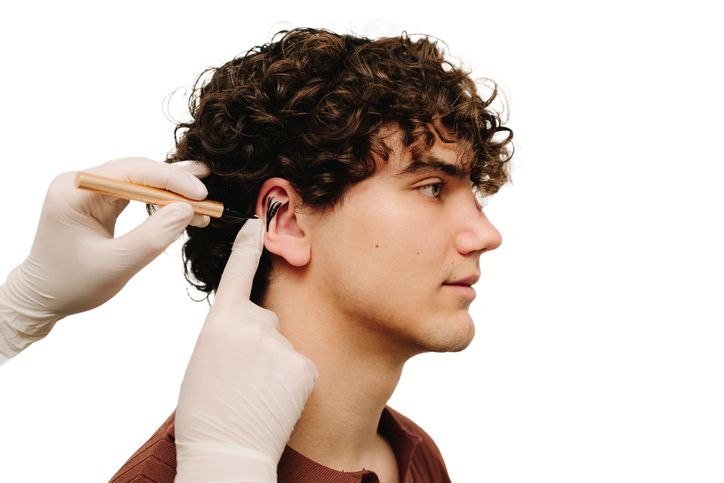
Recovery is quick. Expect mild soreness and some swelling for the first two or three days, managed with simple painkillers. Sutures are usually removed at about a week, or dissolve on their own depending on what your surgeon uses.
Most people return to work within a couple of days. The main thing to protect against is anything that pulls or catches the ear, so avoid over-the-head clothing, sleeping directly on the side, and contact sport for the first few weeks. The scar sits along the lobe edge and fades over six to twelve months.
There is always a scar, because the procedure works by removing tissue. What makes it inconspicuous is placement: the incision is designed to sit along the natural edge or the back of the lobe, where the eye does not look for a line.
Early on it will be pink and slightly firm. Over six to twelve months it usually pales and flattens. People prone to keloid or thickened scarring should say so at consultation, since earlobes are one of the more common sites for keloids and that changes both the technique and the aftercare a surgeon will recommend.
Yes, and it is the usual approach. Doing both together keeps the two lobes symmetrical, since the surgeon can compare them directly during the procedure rather than working from memory or photographs at a later date.
It also means one recovery instead of two. Each ear adds roughly 30 to 60 minutes to the appointment, so treating both still fits comfortably in a single office visit under local anaesthetic.
Often, yes. Earlobe reduction is frequently done alongside otoplasty, which reshapes or repositions the ear itself rather than the lobe, when someone wants the whole ear addressed in one sitting.
It also combines readily with repair of a split or stretched piercing. Combining procedures usually means a single recovery and one set of facility costs, so it is worth raising at consultation even if you had only planned on the lobe.
Après avoir anesthésié le patient, le chirurgien marques, découpes et remodelages le lobe en utilisant un réduction en coin ou en bordure (périphérique) ou un petit rabat ; sutures fines Restauration du contour. La plupart des patients rentrent chez eux immédiatement après.
Des adultes dérangés par lobes d'oreilles longs, lourds ou asymétriques qu'elles soient d'origine génétique, liées à l'âge ou au port de boucles d'oreilles, votre consultation portera sur vos antécédents de cicatrices et… risque de chéloïde et si des réparations antérieures de déchirures/de calibre doivent être combinées.
Les protocoles varient selon la technique et le processus de guérison. Voici quelques recommandations générales : ~6 à 12 semaines avant de percer à nouveau (et loin de la ligne de cicatrice).
Saignement, infection, encoche/asymétrie, cicatrice élargie, récidive (si les boucles d'oreilles lourdes sont portées trop tôt). Les personnes ayant des antécédents de chéloïdes—qui sont plus fréquent sur les lobes d'oreilles—devrait aborder la question de la prévention (par exemple, les bandes de silicone, les injections de stéroïdes).
Un guide raisonnable pour l'ensemble du Canada réduction est ~C$1 000–$3 000+ par oreille, avec jaugeé/complexe Reconstructions plus importantes. Votre consultation vous permettra d'obtenir un devis précis.
Pour le bon patient, il procure un forme de lobe permanente et proportionnée avec un visite courte et temps d'arrêt minimal—à condition de suivre les instructions de soin et d'éviter de porter des boucles d'oreilles lourdes au début.


 English English
  French


